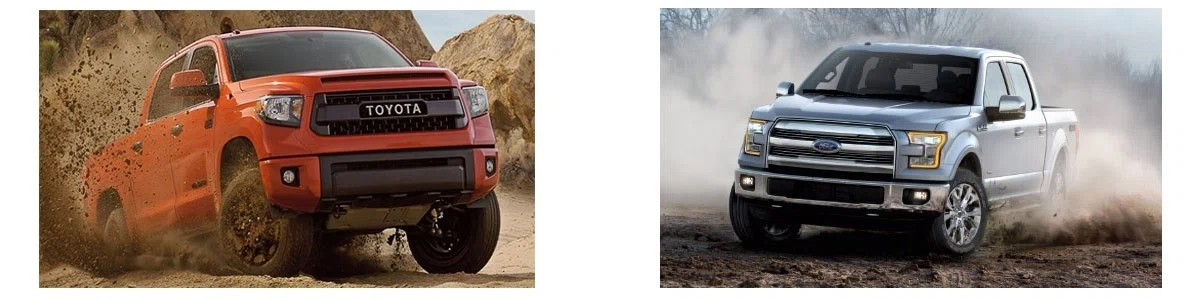
Full-size pickup trucks are typically associated with hauling, towing, and other blue-collar needs, but recently manufacturers have shown a dedication to improving efficiency and comfort. As trucks evolve, they are becoming a popular choice for an ever-widening segment of the car-buying marketplace.
Dealspotr took a look at several reviews from respected automotive publications to create a comparative buyer’s guide between the all-new redesigned 2015 Ford F-150 and the 2015 Toyota Tundra.
Driving and Towing Performance
Ford F-150
Similar to the dramatic and largely-successful overhaul in 1997, this year sees the Ford F-150 being completely redefined once again. The most significant change is the introduction of an all-aluminum body. This unprecedented departure from steel panels cuts down on the vehicle’s weight. Along with other weight-cutting measures, Ford claims the 2015 F-150 has shed up to 700 pounds.
A skeptical Car and Driver Magazine critic put the F-150 to the test, knowing that manufacturers tend to overstate specifications. The critic compared this year’s model with the 2014 model, and though it was a bit of an “apples-to-oranges” test, he was confident the truck had a weight loss of at least 600-plus pounds.
The weight savings give the F-150 improved fuel economy (5-20 percent) as well as increased towing and payload capability. While the F-150 is always a strong performer in towing, it now claims the highest maximum ratings with 12,200 pounds of towing and 3300 pounds of in-bed capability.
Road and Track reviewer David Gluckman notes that a lower center of gravity on the new F-150 results in improved handling and steering when towing cargo. In fact, he goes so far as the claim the improvement in steering is enough to catapult the F-150 from worst-to-first in its market segment.
While Road and Track is extremely bullish on the F-150’s performance, Car and Driver finds the steering to be a bit on the light side and that the brake pedal needs significant improvements due to touchiness and a lack of feedback delivery.
Toyota Tundra
Currently in its second generation, the Toyota Tundra is in many ways the same truck it was back in 2007. The Tundra lineup most recently saw a “design refresh” in 2014, with slight modifications for the 2015 model year.
With the 2015 Tundra, Toyota shows that it still emphasizes power over cabin comfort and ride smoothness. As US News writes, the Tundra cannot compete with the comfort and fuel economy of its longer-running competitors.
The Tundra does well with steering controls, which are quick and precise enough to give the vehicle light-footed maneuverability. Despite this nimbleness, the straight-line steadiness could use some work and has a tendency to get off-center. Edmunds also criticizes the Tundra by saying it has a stiff ride and feels too large on curvy roads.
In addition to its base model, Toyota offers a TRD Pro Off-Road trim package for truck owners that intend to actually leave the pavement. Considering its duo of powerful engine choices, every Tundra model comes with enormous towing capacity.
Advantage: Tie. The ultra-lightweight Ford F-150 offers its owners incredible agility and responsiveness, while the Toyota Tundra doles out raw power without sacrificing too much drivability. Despite the F-150’s light weight, it is able to offer excellent towing capabilities. Conversely, despite Toyota’s focus on towing and power, the Tundra offers a smooth and user-friendly driving experience.
Drivetrain Options and Fuel Economy
Ford F-150
Ford doubled-down on efficiency when they made a 2.7-liter V-6 EcoBoost engine the standard powertrain for the F-150. While it sounds like the kind of engine that should power a sedan, Car and Driver makes it clear that this small engine is anything but a weakling.
By using twin turbochargers and direct injection, the 2.7-liter V-6 punches well above its weight. This powerhouse six-cylinder offers an output of 325 horsepower and 375 pound-feet of torque. Despite its small size, the EcoBoost engine is able to give the F-150 the power of larger, heavier, and less-efficient trucks. The same can be said about the 3.5-liter EcoBoost V-6.
In addition to the 3.5-liter EcoBoost V-6, the F-150 also offers a less-potent DOHC 3.5-liter V-6. Car and Driver states that the upgrade to the EcoBoost engine is worth every cent of the $795 upgrade cost. In fact, even the F-150’s large 5.0-liter V-8 is less expensive and less powerful than the smaller 3.5-liter V-6.
The Ford F-150 comes with a 6-speed automatic that includes a manual shifting mode and can be purchased with rear wheel drive or four wheel drive.
With so much emphasis on lightening up the Ford F-Series and using a smaller, more efficient engine, it is no surprise that the truck performs exceedingly well in the fuel economy department. The 2015 F-150 offers an EPA estimated 13-19/17-24 mpg (city/highway).
Toyota Tundra
Toyota elected to drop its single V-6 engine option for the 2015 model year, sticking with its pair of powerful V-8 powertrains. Despite the sheer power, this aging engine and transmission system fall behind those of the more efficient and advanced full-size trucks at GM, Ford, and Dodge.
The two engines available for the Tundra are a 4.6-liter V-8 or a 5.7-liter V-8. The truck comes with standard rear wheel drive and has an option to upgrade to four wheel drive. US News’ critics finds the 5.7-liter engine provides abundant levels of power as well as smooth drivability, particularly when paired with Toyota’s six-speed automatic transmission.
On the other hand, there are some critics that grumble about the lack of a V-6 offering for the 2015 model year. Some consumers have little need for the all-world power that the 5.7 liter V-8 presents and would appreciate a more fuel efficient option.
The Toyota Tundra offers some of the worst fuel efficiency in its class; the 4.6-liter V-8 has an estimated 14-15/19-20 mpg (city/highway) and the 5.7 liter V-8 an estimated 13-14/17-18 mpg (city/highway).
Advantage: Ford F-150. While the Tundra provides slightly superior power with its 5.7-liter V-8, its correspondingly poor fuel economy and driving performance make it easy to declare the Ford F-150 superior. This advantage is mirrored in US News’ performance scores for the F-150 (9.0) versus that of the Tundra (6.9).
Interior Quality and Comfort
Ford F-150
With the previous generation of the Ford F-Series, a common complaint was the trucks’ rigid ride quality. The good news for consumers is that according to Car and Driver, the 2015 F-150 delivers vast improvements in those areas.
While the cab comfort has improved considerably, Car and Driver did point out that the dash plastics in the F-150 seem to be “low rent,” falling behind industry leaders like Dodge and Chevrolet. US News gives the F-150 a score of 8.3 for its interior comfort level, good enough for a third overall finish in the full-size truck segment.
Toyota Tundra
Though the Tundra has always made its power a selling point, the creature comforts of its interior are also a strong area for the full-size truck. In AutoTrader.com’s review of the Tundra, the reviewer goes so far as to claim the interior is the “most avant-garde of its segment.”
The cabin of the Tundra stays quiet at highways speeds, though there are some jitters when the truck bed is empty. The spacious CrewMax option offers a car-like backseat with tons of leg-room and is able to make even the largest individuals feel comfortable.
US New is not so high on the Tundra’s interior, calling the cabin design and materials “lackluster” in their review and giving the truck an only-adequate 7.4 interior rating.
Advantage: Toyota Tundra. The extended cab of the CrewMax is what puts the Toyota truck over the top. While both full-size pickups offer middling levels of interior comfort, Toyota has the slight advantage in this category.
Safety
Ford F-150
The Ford F-150 comes with a variety of modern safety features including electronic traction, stability control, and anti-lock disc style brakes. Additionally, the truck includes side-impact airbags and side curtain airbags on both sides – the extended SuperCab and SuperCrew cabs offer these side airbags for both front and rear passengers.
The F-150 performed well when put through government crash tests, and the Insurance Institute for Highway Safety (IIHS) gives the truck high marks en route to declaring it a Top Safety Pick. However, some models of the F-150 did experience issues with roll-over roof strength.
US News finds the F-150 to be the safest truck in its class, giving it an impressive 9.4 overall score.
Toyota Tundra
While the F-150 may be tops in safety according to US News, the Toyota Tundra is not far behind. The publication awards it a solid safety score of 9.0. Some safety features of the Tundra include eight total airbags, stability control, and an optional blind spot monitoring system.
The 2015 Tundra receives high marks on government crash tests with a 4/5 rating. The CrewMax had a few issues in frontal impact and rollover tests, only gaining a 3/5 score in those categories. As with the F-150, the IIHS was impressed with the Tundra, giving it a “Good” score for every safety category.
Advantage: Ford F-150. The Ford F-150 and Toyota Tundra offer excellent safety and only slight issues with a few body styles, but the Ford eked out a slightly higher score.
Long-Term Reliability and Value
Ford F-150
The Ford F-150 does decently on reliability, netting a 3/5 rating from the experts at US News. One concern reviewers had with the F-150’s new aluminum body is that the panels will be more expensive to replace than those of a traditional steel body.
Toyota Tundra
Reliability is a category that Toyota’s entire fleet of vehicles has consistently done well in; the Tundra is no exception to this trend. Earning a 3.5/5 reliability score from US News, the Tundra offers exceptional re-sale value for its owner.
Advantage: Toyota Tundra. This is a difficult area to defeat any Toyota vehicle. While the Ford F-150 is certainly a solidly reliable model, it simply is not at the same level.
Cost
Ford F-150
MSRP: $25,800 - $55,070
Toyota Tundra
MSRP: $28,510 - $47,975
Advantage: Toyota Tundra. While its low-end is a little higher than the Ford F-150, the Tundra is generally a lower-priced vehicle.
Despite a variety of strengths and weaknesses, the Ford F-150 and the Toyota Tundra are quite evenly-matched full-size trucks.
Most publications give an advantage to the F-150 due to its revolutionary redesign and exceptional weight-cutting measures, but the Tundra is quite highly-rated as well and a favorite for being “Made in America” and offering excellent reliability.