There have been dozens of comparison articles between the Apple Watch and other leading smartwatches like the Moto 360.
One comparison is often overlooked, however: How well would the Apple Watch fare against the first digital watch, the 1972 Pulsar P1 by Hamilton Watch Company?
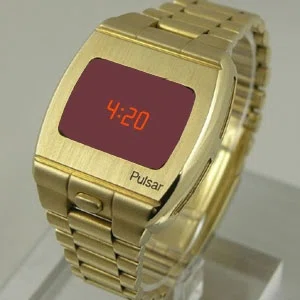
At first glance, a direct comparison may seem a little unfair. The Apple Watch benefits from 43 years of technological progress, which includes, among other things, the invention of the lithium-ion battery, the Internet, personal computing and smartphones.
Nevertheless, there are a surprising number of features on the 1972 Pulsar P1 that made it revolutionary in its day.
For one, the Pulsar P1 was the first watch to feature no moving parts thanks to its 25-chip circuit, making it the first digital watch. The Pulsar P1 was also the first watch to have an LED display, a technology that served as the predecessor to the AMOLED screen that the Apple Watch uses. Like the Apple Watch, the Pulsar P1 conserved power by lighting up its display on an “on-demand” basis.
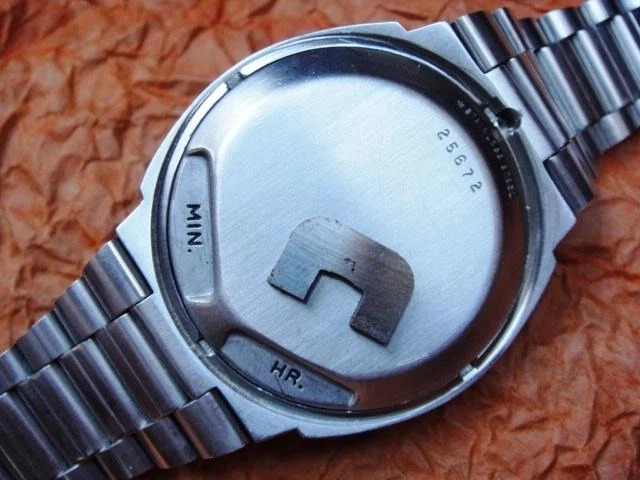
One of the most interesting things about the Pulsar P1 is how it set the time. Because the Pulsar P1 had no moving parts, there were no knobs to turn or dials to set. Instead, there was a small, horseshoe-shaped magnet hidden in the band that could be removed and pressed up against one of two grooves on the back of the Pulsar P1, one for hours and one for minutes.
Other shared features between the Pulsar P1 and the Apple Watch is the inclusion of an ambient light sensor, which determines the screen’s brightness based on the lighting conditions, a tough, scratch-resistant display, as well as an 18-karat gold housing.
Here’s a brief rundown of how the Apple Watch Edition stacks up against the Pulsar P1:

The above charts shows the Pulsar P1 beat the Apple Watch Edition in water resistance and battery life. Of course, simply showing the time isn’t as battery consuming as the myriad functions on the Apple Watch, however considering the Pulsar P1 was made over 40 years ago, a year’s worth of battery life is still quite the impressive feat. The Pulsar P1’s ability to resist water up to 100 feet is largely owed to its hermetic seal, which was made possible by the absence of charging connectors and moving parts.
Naturally, the Apple Watch can do tons of things that the Pulsar P1 could only dream of, but considering it was the same year that Pong came out, it’s still pretty impressive. While we can’t say what the next 43 years for wearables will hold, it’ll be interesting to see if the Apple Watch will be considered as ground-breaking as the Pulsar P1.
Photos courtesy of retroleds.com and crazywatches.pl