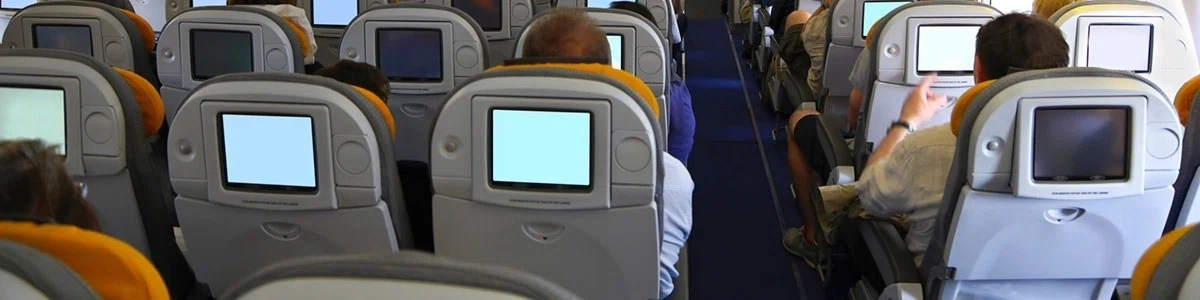
There are a number of things to consider when choosing a flight or airline. The price of the ticket is usually the first consideration. But after that, one of the main factors many passengers take into account is in-flight entertainment.
In-flight entertainment, or IFE, as we know it today, began in 1961 when TWA became the first commercial airline to show an in-flight movie on a scheduled flight.
Today’s in-flight entertainment systems have evolved significantly since then. Even the armrest-controlled audio stations and suspended overhead movie screens that were standard in the ‘80s and ‘90s are fast becoming a thing of the past.
While outdated systems such as those are still found on some aircraft, modern airlines compete to outdo one another by offering the most lavish and sophisticated in-flight entertainment possible.
In the 21st century, in-flight entertainment has evolved massively and can now be delivered via armrest controls, mutual overhead screens, dedicated back-seat screens, and handheld units.
Many airlines even allow passengers to connect their own devices to entertainment systems so they can watch their own content on their back-seat screen.
So which airlines have the best in-flight entertainment?
We’ve looked at the research and this is what we discovered are the five top airlines for in-flight entertainment.
When you consider that Virgin America’s corporate parent is an entertainment company, it makes sense that the airline would boast superior entertainment offerings. Techhive called Virgin America’s IFE “by far the most advanced and feature-packed of any domestic airline.
Virgin America’s entertainment system, known as RED, offers newly released movies, 18 channels of live broadcast TV and basic cable, music videos, games, and songs from the airline’s extensive music library, all at the tap of a touchscreen.
Every flight is equipped with Wi-Fi and there are standard power and USB plugs in every seat. There’s even an in-built chat system that allows you to chat with friends and family in other parts of the plane.
Another of RED’s unique features is the ability to place food and drink orders from your seat using your touchscreen and a built-in credit card swipe.
JetBlue’s IFE system features personal seat back screens for every passenger and offers free access to 36 live DIRECTV channels including ESPN, FX, CNN, Bravo, Discovery and Comedy Central.
Some of the airlines’ newer A321 aircraft now offer passengers more than 100 DIRECTV channels to choose from. The system also provides access to over 100 SiriusXM radio channels including music, sports, news, politics, entertainment and health channels.
While most entertainment on JetBlue flights is free, first-run movies are available on domestic flights for a small fee. Most JetBlue aircraft are now equipped with Wi-Fi through JetBlue’s proprietary Fly-Fi system. JetBlue is currently working to enable all its aircraft with Wi-Fi.
Air Canada’s enRoute In-flight Entertainment system features personal touchscreen TVs for every seat. In addition to a moving map that follows the plane’s flight path, enRoute offers passengers hundreds of hours of on-demand audio and video entertainment.
Video entertainment on Air Canada flights includes up to 150 movies of differing genres, including the latest studio and independent releases, as well as nearly 200 TV shows. Passengers may also enjoy over 100 albums and playlists, audio books and podcasts.
Each seat on an Air Canada flight also features audio jacks for passengers’ own headphones and power and USB ports to keep devices fully charged. Since 2009, Air Canada has offered IFE from gate to gate, meaning the system remains on even for takeoff and landing.
Alaska Airlines is another of the domestic carriers that’s leading the way in IFE. The Airline recently introduced Alaska Beyond Entertainment, a service that enables passengers to stream movies, TV shows and exclusive content over their own devices while in-flight.
Most of Alaska Airlines’ planes now offer direct-to-your-device entertainment powered by in-flight web and entertainment provider, Gogo. All content for Alaska Beyond is hosted by onboard servers, each carrying nearly two terabytes of data.
One nice byproduct of the content being hosted onboard is that streaming movies and TV while in-flight doesn’t interfere with passengers’ ability to access in-flight internet for sending emails or updating social media.
How good is Emirates Airlines’ in-flight entertainment you ask? Good enough to win the World Airline Awards Best Inflight Entertainment Award for 11 years running. According to Business Insider, Emirates features “the best in-flight entertainment system in the world.”
All seats on Emirates flights feature a dedicated back-seat system. Known as the ICE Digital Windscreen, the system puts news, sports, and information right at passengers’ fingertips.
The ICE (Information, Communication, Entertainment) system’s connectivity features allow passengers to make phone calls, send texts, and emails, right from their seats. And when it comes to entertainment, ICE provides more than 2,000 premium entertainment channels with the latest and best in movies, TV shows, music, and games.
Conclusion
It’s notable that most of the airlines on this list are relatively newer ones. Many “legacy” airlines like American, Delta and United have fallen behind somewhat in the in-flight entertainment race. Part of the problem stems from having large fleets consisting of older aircraft alongside newer ones. This leads to inconsistency in terms of the kind of IFE found on one flight to the next.
A good general rule of thumb is, that if you’re looking for quality in-flight entertainment, you might want to book your flight with a younger airline.